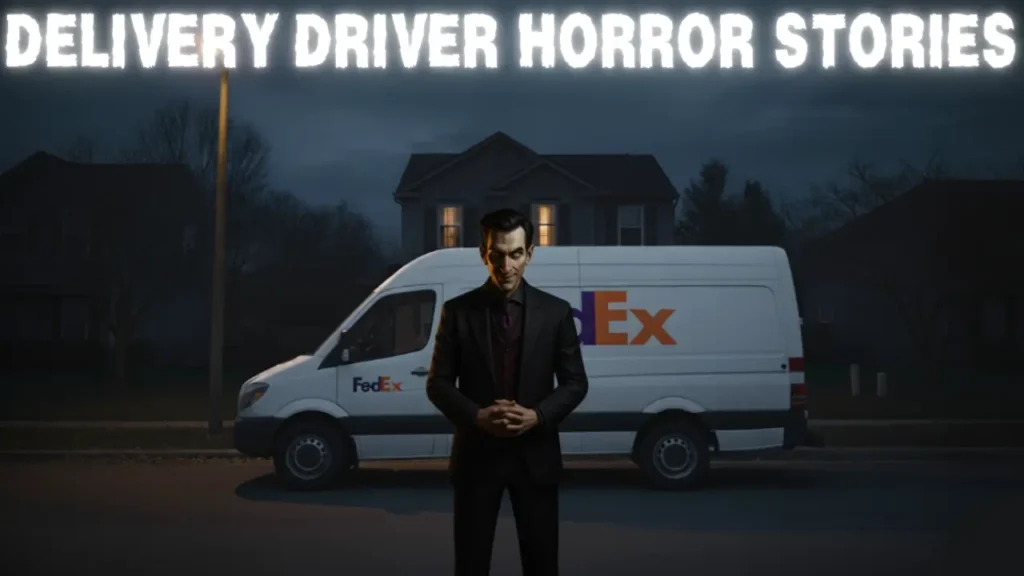
3 TRUE DELIVERY DRIVER HORROR STORIES (DOCUMENTED) PREVIEW
These three delivery driver horror stories are based on true events.
What happens when a routine route turns into a descent into madness?
A delivery driver confronts a chilling family that seems to defy space and time, another finds themselves trapped in a digital maze of non-existent addresses, and a third uncovers a terrifying secret hidden in plain sight.
Watch me on YouTube and listen to me on Spotify.
Horror Story One: The Glitch on Route 47
David pulled the big delivery truck to a stop and killed the engine.
The sudden quiet was heavy.
He looked at the house, a cheerful yellow place with a perfectly green lawn.
Then he looked at the porch.
A cold, heavy feeling sank in his gut.
It was them.
The same family.
He’d seen them at the last house, ten minutes ago and miles away on a different road entirely.
A tall, skinny man in overalls.
A woman behind him who looked just like a sister, with the same pale face and empty eyes.
And a little boy, a carbon copy of the man, hiding behind her legs.
They just stood there, staring.
It made no sense.
His mind raced, trying to find a logical reason, but there wasn’t one.
Just twenty minutes earlier, his day had been perfectly normal.
The steady drone of the truck’s engine had been the only sound for miles.
It was late spring in rural Virginia, and the windows were down, letting in the smell of cut grass.
David was new on this route, just trying to keep on schedule.
The GPS on his dashboard chirped, showing him the next stop was down a long, winding road deep in the pines.
He turned the truck down a long gravel driveway that crunched loud under the tires.
The road ended at a small, two-story farmhouse.
The place looked old, with gray paint peeling off the wood like sunburned skin.
As he brought the truck to a halt, the engine noise died down and all he could hear was the ticking of it cooling.
That, and a strange, deep silence.
No birds, no bugs, nothing.
He grabbed the package off the passenger seat and hopped down from the cab.
As his boots hit the dirt, the screen door of the house let out a long, rusty groan.
The man in overalls stepped out.
Then the woman, then the boy peeking from behind her.
They all had the same blank look, like mannequins in a store window.
David was a practical guy.
Weird people existed.
It wasn’t his job to figure them out.
He walked right up to the porch.
“Package for the Jenkins residence?” he said.
His own voice sounded loud in the dead quiet.
The man didn’t say a word.
He just reached out and took the box.
His fingers brushed against David’s, and his skin was shockingly cold, like it had been stored in a refrigerator.
The man gave a slow, small nod.
Then the three of them turned, went back inside, and the screen door creaked shut.
David stood there for a second, a strange chill crawling up his arms.
He shook it off and walked back to his truck.
He had a schedule to keep.
He pulled back onto the main road.
The GPS chirped again with the next location, a house in a subdivision a few miles away.
As he drove, he felt the truck bounce hard after hitting a pothole.
The GPS screen went black, then flickered back on.
At the same time, he heard a new sound.
It was a faint, metallic clicking coming from the engine, like a rock was caught somewhere it shouldn’t be.
He tried to ignore it.
The houses got farther apart, and the woods got thicker.
And that’s when he saw it.
The cheerful yellow house in the subdivision.
And the same family on the porch.
Staring at them now, frozen in his driver’s seat, David’s brain felt like it was short-circuiting.
This was wrong.
This was impossible.
The first time was just odd.
The second time was a break in reality.
Their eyes, all three pairs, were locked on him.
They weren’t looking at the truck, or at the package he was supposed to deliver.
They were looking right through him, with a look that said they knew him.
That they were waiting for him.
He had to move.
He had to finish the job.
He grabbed the package—another box, for a different name at this new address—and got out.
Each step felt like he was walking through thick mud.
The metallic clicking from his engine seemed louder out here, a constant reminder that things were broken.
He walked up to the porch and held out the box.
The man took it.
Again, the cold fingers.
Again, the slow, empty nod.
Again, they turned and disappeared behind the creaking screen door.
David didn’t wait around.
He turned, walked back to the truck as fast as he could without running, and climbed inside.
His heart was hammering against his ribs.
The silence of the place was the worst part.
It felt like the whole world was holding its breath, just for him.
He cranked the engine.
It turned over with a rough, grinding sound, and the clicking was faster now, more insistent.
He just had to get away.
He just had to finish the route.
The GPS chimed.
Its friendly little sound now felt like a threat.
The last stop: a remote house at the far edge of the county.
A deep sense of dread settled over him.
He knew what he was going to find.
He didn’t want to go, but the truck seemed to steer itself, turning down a long dirt road that cut through a field of tall, dead weeds.
The weeds scraped and scratched against the side of the truck, a dry, whispering sound that made his skin crawl.
The engine’s clicking was frantic now, a fast, rhythmic beat matching his own terrified pulse.
The house was a small brick bungalow.
Different house, same story.
The screen door groaned open, and the family stepped out onto the porch.
The man, the woman, the boy.
A silent welcoming party at the end of the world.
He was holding the last package in his hand, though he didn’t remember grabbing it.
His body was just going through the motions.
This time, David didn’t get any closer.
He stood in the dusty driveway, the engine still running, still clicking.
The man on the porch held out his hand.
A silent order.
David didn’t even think.
He just threw the package.
It landed at the man’s feet with a soft thud.
The man bent down, picked it up, gave that same slow nod, and then they were gone.
David scrambled back into the driver’s seat and slammed the door.
He fumbled for his phone, his hands shaking so much he dropped it twice.
He finally managed to call his supervisor, Mike.
His voice came out as a raw whisper.
“Something’s wrong out here.
You have to believe me.
The same family, at three different houses.
Three different packages.”
Mike’s voice on the other end was full of doubt.
“David, are you feeling okay?
You sound spooked.”
Minutes later, the sound of a police siren cut through the awful quiet.
A county sheriff’s car pulled up behind him.
The officer who got out was a man named Collins, someone who knew his uncle.
David had never been so relieved to see anyone in his life.
“They’re in there,” David said, his voice trembling as he pointed at the bungalow.
“The family.”
Officer Collins walked up and knocked on the door.
The man who answered was not the man from the porch.
He was fifty-something, with gray hair and a friendly, confused face.
“Can I help you, officer?”
Officer Collins looked from the man back to David, who just stared in disbelief.
“We’re just checking a report, sir.
You the homeowner?”
“Yes,” the man said.
“Lived here thirty years.
Is something wrong?”
They drove to the other two houses.
At the yellow ranch, they met a young couple with a toddler.
At the old farmhouse, an elderly woman who had lived there her entire life.
They were all different people.
Normal people.
All three had signed for their packages.
Back at the station, the air smelled like stale coffee and old files.
David gave his statement, his hands still shaking.
Officer Collins was patient, but he was baffled.
“I don’t know what to tell you, David,” he said, shaking his head.
“The packages are all accounted for.
Signed for by three different residents at three different addresses.
It’s all here in the system.”
The official report was filed.
They called it a “testimony of unexplained events.”
The details were all there—the times, the confirmed deliveries.
It was a documented event with no explanation.
A story with all the facts lined up, but the facts made an impossible picture.
David quit his job the next week.
The sound of a big truck engine now makes a sick feeling rise in his chest.
He still lives in that town, but he’s not the same.
He’s quieter, and his eyes are always scanning, searching.
Every time he sees a family on the street, he looks for a shared emptiness in their faces.
He still doesn’t know what happened on Route 47.
He doesn’t know if he drove through a glitch in the world, or if he just saw something he wasn’t supposed to see.
But sometimes, when the house is dark and the night is quiet, he can still hear it.
That faint, rusty sound of a screen door groaning open.
Horror Story Two: No Such Address
The phone mounted on the dash spoke in a flat, robotic voice.
“You have arrived at your destination.”
Izzy looked up from the glowing screen.
The phone said she was there.
The real world said otherwise.
Her sedan’s headlights cut a bright tunnel through the pitch-black Oregon night, and at the end of that tunnel was nothing.
Just a rusted barbed-wire fence lining a massive, overgrown field.
The wind made the tall grass sway.
There was no house, no driveway, no mailbox.
Nothing to show a person had ever lived there, or ever would.
Her delivery app, however, was certain.
A prompt glowed on the screen: “Leave package at front door.”
A cold feeling started in her chest and spread outwards.
This was wrong.
But the app was the boss.
She grabbed the first package, a small plastic mailer that felt too light, and pushed the car door open.
The sound of the wind and the steady chirp of crickets rushed in.
It was a deep country quiet, the kind that feels heavy, like it’s listening.
In the far distance, a dog started howling, a long and lonely sound that the wind carried away.
She walked to the fence line, placed the package on the dirt, and pulled out her phone.
The flash from the camera was blinding for a second as she took the proof-of-delivery photo.
Back in the car, she locked the doors with a loud clunk and put the car in drive.
Her phone chimed.
“Delivery complete.
Proceed to next stop.”
The next few stops were just as bad, maybe worse.
The GPS led her down a dirt road so overgrown that branches scraped and screeched along the sides of her car.
It ended in a clearing.
There was no house here either, just a cracked concrete foundation sticking out of the weeds like a set of broken teeth.
A single, rusty mailbox stood crookedly by the entrance, its door hanging open.
The name on the side was long gone, peeled away by years of sun and rain.
The app buzzed.
“You have arrived.”
She went to place the second package inside and glanced at the shipping label.
There was no name, just the address.
Strange.
The third stop was an empty lot.
The only thing there was a small, metal swing set.
The paint was faded and peeling, and the actual swings were gone, leaving just the A-frame and the empty hooks that swayed a little in the wind.
As she got out of the car, she could hear it making a thin, scraping squeak each time it moved.
Squeak… squeak… a steady, lonely noise in the dark.
It was a place where a family used to be.
Now, it was just a memory.
She put the package on the ground beneath the empty swings.
She checked the label again, confirming it.
Just like the last one.
No name, only the address.
Fear was building on her now, cold and solid.
This wasn’t a glitch.
This was a pattern.
She drove a quarter-mile down the road, pulled over onto the gravel shoulder, and killed the engine.
Her hands felt tight on the steering wheel.
She took a deep breath and called Amazon support.
After a few rings, a cheerful man’s voice came on the line.
“Thank you for calling Amazon, my name is Mark!
How can I help you?”
Izzy tried to keep her voice steady.
She explained the situation.
The empty fields, the demolished house, the swing set.
She told him every address was wrong, that there were no houses, no people.
Mark was quiet for a moment.
She could hear him typing, the soft click-clack of his keyboard.
“Well, Izzy,” he said, his voice still perfectly pleasant, “I’m looking at your route right now, and everything seems to be in order.
The GPS data shows you’ve successfully delivered to each correct location.
There are no issues flagged in the system.”
“But there are no houses,” she repeated, her voice rising.
“I’m telling you, there is nothing here.”
“The system says the addresses are valid, Izzy,” he said, as if explaining something to a child.
“Sometimes in rural areas, the properties can look a little different.
I’m sure everything is fine.
Just complete your last delivery and you’ll be done for the night.
Have a great rest of your shift!”
The line went dead.
He hadn’t listened.
Or he couldn’t understand.
To him, if the computer said it was true, it was true.
She was alone out here.
The feeling was worse than the fear.
It was a heavy, sinking feeling of being completely cut off.
She had one package left.
One more of these strange, nameless packages.
Starting the car, she pulled back onto the empty road.
The dread was a physical weight now.
Every shadow the headlights cast seemed to jump and twist.
Every rustle of leaves sounded like footsteps.
The GPS told her to turn onto another narrow gravel road.
She slowed the car to a crawl as her lights landed on the final address.
It wasn’t an empty lot this time.
It was the skeleton of a house.
A two-story house that had burned down a long, long time ago.
All that was left was the blackened wood frame.
The walls were gone, the roof had caved in, and the windows were just black, empty holes staring out at her.
It was a tomb.
A monument to some past disaster.
And on her phone, the app glowed with the same instruction it always did.
“Leave package at front door.”
She couldn’t move.
Her body was frozen.
She had to get out of the car, walk up to that ruin, and leave the package.
It was the only way to finish the shift, the only way to make this night end.
Her eyes scanned the dark frame of the house, and then she saw it.
Deep inside the ruin, through what used to be a downstairs window, a light flickered.
It was a small, unsteady flame.
A single candle, sitting on something in the middle of the charred floor.
Its warm glow was the most terrifying thing she had ever seen.
It was a sign of life in a place that was completely dead.
It meant someone was in there.
Someone was waiting.
That broke the paralysis.
She didn’t think, she just moved.
She threw the car door open, ran to the edge of what would have been the front porch, and dropped the last package in the dirt.
She fumbled with her phone, snapped the required photo without even looking, the flash lighting up the black bones of the house for a split second.
She sprinted back to her car, threw it in reverse, and stomped on the gas.
Gravel sprayed as the tires spun.
She didn’t slow down until the ruined house was gone from her rearview mirror, swallowed by the night.
As she hit the paved road, her phone made its cheerful little chime.
“Delivery Complete.
Your route is finished.”
Months have passed.
Izzy quit doing night shifts.
She only works in the daylight now, when the world is solid and makes sense.
The company’s digital records are perfect.
They show a flawless night of deliveries to valid addresses in rural Oregon.
The empty fields, the broken foundations, and the burnt-out house don’t exist in their world.
Officially, that night never happened the way she remembers it.
But it happened.
And just last week, Izzy saw something that made all that cold fear rush back.
She was finishing a daytime route near the edge of town when she saw a familiar compact sedan turn onto one of those long, winding country roads.
It was another driver.
A young woman, just like her, probably starting a night shift to make some extra money.
Izzy watched the car’s taillights disappear into the treeline, heading toward the same dark places, sent to deliver those same strange, nameless packages.
Her hand went to her phone—to do what, she didn’t even know.
Warn her?
Call support again?
She pulled her hand back and gripped the wheel.
It was someone else’s route now.
Horror Story Three: The DoorDash Disappearance Protocol
In 2022, Southeast Texas had a way of getting quiet.
It was a heavy, humid quiet that settled over the landscape, broken only by the sound of cicadas or a truck passing on some forgotten backroad.
In this world of long shadows and overgrown fields, a young man named Jake was trying to make a living.
He drove for DoorDash, a lonely job navigating dark roads at night.
His only real goal was to make enough cash to fix his old truck and get out of that corner of the world for good.
His life was a simple loop of fast food pickups and porch drop-offs, right up until the day the pattern changed.
The app made its usual chime, but the order that lit up his screen was different.
The payout was huge, more than he’d ever seen for one job.
But the address was way out in the woods, down a dirt road that looked like it just ended in darkness.
The order was simple enough: a burger and a large soda for someone named Evelyn.
He paused for a second.
Something about it felt off, but the thought of that payday was enough to make him push his doubts aside.
He hit accept.
The drive took him miles off any paved road.
His truck complained the whole way, rattling and groaning down the overgrown path as his headlights cut a hole in the thick, black night.
The air got heavy and still.
The only sound was the crunch of his tires on dirt and gravel.
When he finally got to the address, he found an old farmhouse, half-eaten by weeds and vines.
The porch looked like it was about to collapse, and the windows were like empty black eyes.
A nervous feeling started up in Jake’s chest.
He killed the engine, and the world went completely dead.
No bugs, no wind.
Just a thick, heavy silence.
He got out of his truck.
The sound of his own boots on the gravel seemed way too loud.
He walked up to the house, the food bag in his hand, and pulled out his phone to check the instructions again.
The app was specific: ‘Hand it to customer.’
It wanted a warm handoff, for him to actually make contact, not just leave the food on the porch.
So he knocked on the rotting wood of the door.
The sound was dull, absorbed by the silence.
He waited.
Nothing.
He called out, “Delivery for Evelyn!”
His voice just vanished into the air.
After another minute of waiting, he decided to ignore the prompt.
This was good enough.
He set the bag down, took the required photo for the app, and walked back to his truck.
He was just about to put it in drive when a sharp crack against his passenger-side window made him jump out of his skin.
A figure was standing there in the shadows, perfectly still.
Jake’s breath caught in his throat.
He couldn’t make out a face, just the dark outline of a person.
For a long, cold moment, nothing happened.
Then, the figure slowly lifted a hand in a small, polite wave before melting back into the darkness.
Shaken, Jake stomped on the gas and got out of there, the massive tip already showing in his account.
He told himself it was just a strange customer, but the cold feeling didn’t go away.
Over the next two weeks, the weird orders kept coming.
Each one had a huge tip, and each one led him to some remote, empty place.
He delivered food for “Michael” to an abandoned trailer park.
He delivered to “Sarah” at a diner that had been shut down for years on a highway nobody used.
Every time, it was the same routine.
A deserted spot, that same unnerving quiet, and the feeling of being watched.
One night, he was scrolling on his phone when a local news headline caught his eye: “Police Continue Search for Missing Residents.”
A cold weight settled in his gut.
He clicked the link.
The article listed several names of people who had vanished from the area.
The first three were Evelyn, Michael, and Sarah.
He felt sick.
He tried to tell himself it was just a coincidence.
Those were common names.
He was just tired, working too late, letting his mind play tricks on him.
But the giant tips, the timing, the empty locations… it all pointed to something else.
He spent the next few days in a fog, digging online.
He found public police files, checking names and last-known locations.
Every single time, the pieces fit.
He was delivering food to the exact spots where these people had last been seen.
He thought about going to the cops, but what could he say?
That he had a bad feeling about some food deliveries?
They’d think he was a crank.
He was trapped, knowing he was either losing his mind or part of something horrible.
Then, the last order came through.
The app chimed.
The name was ‘Jack.’
Jake’s mind went blank for a second.
He immediately told himself to calm down.
It was just a name.
A common name.
After the last few weeks, he was probably just seeing ghosts everywhere, connecting dots that weren’t there.
He was letting the fear get to him.
He was about to decline the order, to shut his phone off and chalk it up to his own paranoia, when his eyes fell on the delivery address: the old, abandoned warehouse just outside of town.
The combination was a punch to the gut.
The name, plus that specific, dreaded place.
Any doubt he had was instantly erased and replaced by a cold, terrifying certainty.
Now, all he could think about was his friend Jack, who had disappeared six months earlier.
They weren’t just casual friends; they’d worked together for two years stocking shelves at the local grocery store before Jake started driving full time.
It was the kind of friendship built on long, boring shifts and complaining about the same managers.
The police wrote it off, said he probably just ran away.
Jake never believed it.
He knew Jack was saving up for a car, not planning to vanish.
He stared at the phone, his hand shaking.
He had to know.
He had to see for himself.
He drove to the warehouse, his truck shaking so bad it felt like the engine was as scared as he was.
This time, he left it running.
He got out and walked toward the massive, dark building, the sound of his own breathing loud in his ears.
He circled around the side, using his phone’s flashlight to see.
The weak beam landed on a small door, half-hidden by a bush.
It was unlocked.
He pushed it open and stepped inside.
The air was thick with the smell of damp concrete and rot.
His flashlight beam cut through the dark and landed on something in the middle of the room.
It was a collection of things, set up on an old crate.
Wallets, keys, cell phones, pictures.
They were arranged like tools on a workbench, too neat, too perfect.
He saw Jack’s wallet.
He saw the goofy smile on his driver’s license photo staring up at him.
A soft shuffling sound from a dark corner made him whip around.
His light swept across the room and stopped on a figure, standing silently in the shadows.
He saw no face, just a silhouette.
There was no fight.
There was no scream.
In that moment, Jake understood.
He wasn’t crazy.
He had been right all along.
The fear he’d been feeling wasn’t paranoia; it was a warning.
And now he was standing in a room with the reason for it.
He didn’t wait to see what would happen next.
He turned and ran.
He bolted out the door, his heart hammering against his ribs, and didn’t stop until he was back in his truck.
He slammed the door, threw it in gear, and sped away, the roar of the engine the only sound he made.
He drove straight to the police station.
He was a wreck, barely making sense, talking about DoorDash and missing people.
But he was clear about one thing: the warehouse.
The cops were doubtful, but they sent a car to check it out.
They found the shrine.
The case of a few missing people suddenly became a full-blown homicide investigation.
But the killer was gone.
The warehouse was empty except for the chilling display left behind.
The story hit the local news, and for a little while, they called Jake a hero.
Jake’s story might sound like a nightmare, but in a place like Texas, it’s a reality that’s far more common than most people dare to imagine.
In 2024 alone, over 44,000 missing persons reports were filed across the state—that’s more than a hundred people every single day.
In the isolated, rural counties of Southeast Texas, small and overwhelmed police forces often lack the resources to handle even one long-term case, let alone the thousands that remain unsolved.
The truth is, a story like Jake’s isn’t just a chilling tale.
It’s a reflection of a grim reality where, on any given night, on any dark road, anyone could be just one delivery away from vanishing forever.