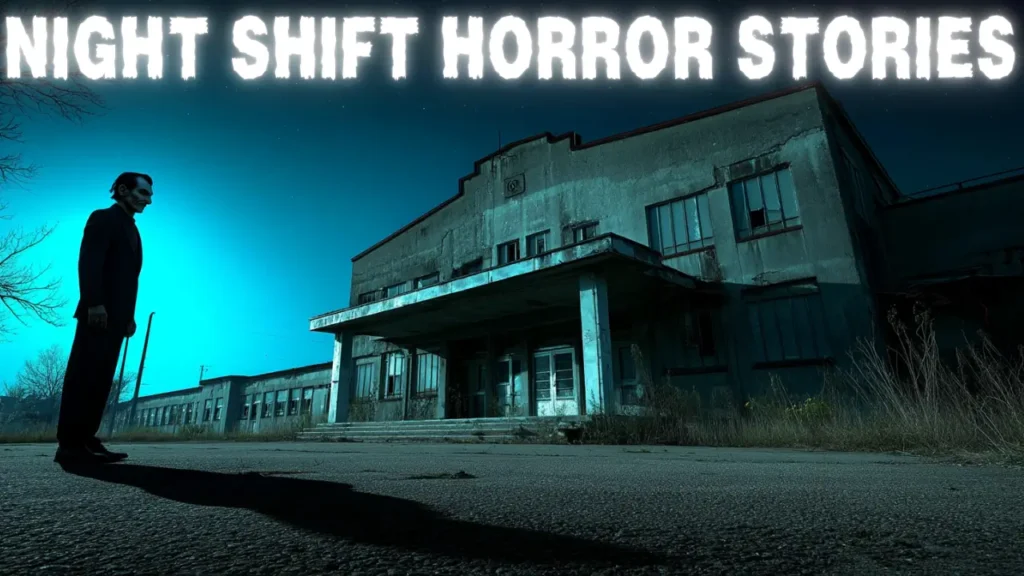
3 TRUE NIGHT SHIFT HORROR STORIES PREVIEW
These three true night shift horror stories are based on real events. 💀
The first story follows Hazel, a night nurse at the West Mountain Sanitarium, who is terrorized by the vengeful spirit of a patient named Cole.
The second story is about Miller, a security guard at Monaghan Mill, who uncovers a dark history of child exploitation, experiencing strange phenomena that are rooted in the mill’s past trauma.
The third story features Amelia, a guard at a haunted mall in Columbus, Ohio, who is tormented by the ghost of a child who died there.
Watch me on YouTube and Spotify.
Horror Story #1
Amelia wasn’t the type to believe in things that go bump in the night.
She’d been an EMT, a job where you see real problems and find real solutions.
Logic was her tool.
So, when she took the security contract at an abandoned mall on the outskirts of Columbus, Ohio, she treated it like any other job.
The place was a husk, a relic from the 80s that had been sitting empty for a decade.
It was a known fact that online shopping and a newer, fancier mall nearby had killed it.
That was just business.
But the locals had a different story.
They said the place was cursed, haunted by the ghost of a three-year-old kid who fell from the second floor there back in 1983.
To Amelia, that was just talk.
A story people told.
Her job was the reality.
The reality was walking miles of empty hallways every night, the only sound the squeak of her boots on the dirty tile.
Her job was a simple checklist: rattle the service doors, check the motion sensors, make sure no one had broken in to steal copper wire.
It was boring, quiet, and lonely work.
On her first couple of nights, the biggest excitement was a leaky pipe in the old food court.
The ghost stories were just something to joke about over the radio with the other guards to stay awake.
That changed on her third night.
A sharp beep came from her monitor.
Motion detected.
The alert was from the back of the old Toys ‘R’ Us, a store that had been locked up and dark for years.
Amelia switched the monitor to the right camera.
The feed was grainy, but she saw it clear enough.
For just a second, a blurry shape shot down an aisle of empty metal shelves.
It moved way too fast to be a person.
Then it was gone.
The sensor went dead.
She rewound the footage, but the shape was just a blur.
“Faulty sensor,” she muttered, typing the detail into her nightly report.
It was a logical explanation.
But the logical explanations started to wear thin.
The mall began to show her things that didn’t make sense.
A few nights later, she was doing her rounds in a closed-off wing.
Her flashlight beam swept across the storefronts, covered in a thick layer of dust.
She stopped.
On the glass of a clothing store, right about knee-high, was a handprint.
It was small, damp, and perfectly clear against the grime.
There was no way a kid could have gotten in there.
She was the only one with keys to that section.
She tried to explain it away.
Maybe it was an old print and the way the moisture settled made it look fresh.
It was a weak theory, but it was better than the alternative.
The weirdness continued.
One night, a different sound broke the silence.
From the direction of the sealed-off movie theater, she heard the distinct, sharp sound of a single theater seat slamming down into its open position.
She pulled the camera feed for the theater.
All the seats were up, just as they should be, covered in dusty plastic sheets.
She watched the feed for ten minutes.
Nothing.
Not even a mouse.
She wrote it off as the building settling, but the thought didn’t feel right.
The following week, she found the footprints.
She had just finished mopping a spill in the food court and had locked the security gate behind her.
An hour later, on her next pass, she saw them.
A line of small, bare footprints started in the middle of the floor near the old Cinnabon.
They were clear as day in the thin layer of dust on the tiles she hadn’t mopped.
She followed the trail.
It led straight to a locked utility closet and just… stopped.
Right at the metal door.
As if a kid had walked right through it.
This time, she had no explanation at all.
That’s when she really started to notice the cold.
Not the general, drafty chill of a dead building, but a focused, moving cold.
She’d be walking a corridor and the temperature would just drop.
Her patrol cart had a digital thermometer, and she watched it fall fifteen degrees in a matter of seconds.
The cold brought a sound with it—the faint, distant giggle of a child, seeming to echo from the dark, inaccessible second floor.
Then would come another sound: the steady thump-thump-thump of a small rubber ball bouncing on the floor.
But every time she’d hurry around the corner, flashlight out, the sound would stop.
The cold would fade.
And there was never, ever a ball.
It felt like a game, and she was the only one playing.
A cold dread began to settle in her stomach.
She was being watched.
She knew it.
The situation came to a head on her final night.
It all centered on the main freight elevator.
It was the only way to the second floor, but it had been shut down for years.
From the security office, she watched on her monitor as the elevator suddenly came to life.
The machinery made a low, mechanical drone as the car started moving between the first and second floors.
Up, then down.
The doors would slide open, show an empty car, and then close again.
Over and over.
It wasn’t random; it was methodical, as if someone was inside, riding it.
She had to see it for herself.
She left the office, her footsteps the only sound besides the steady drone of the elevator machinery somewhere above her.
She stood before the heavy steel doors on the first floor, looking up.
The sound of the motor was constant.
Then, through the small gap between the doors, she saw a shadow move on the second floor.
It was small and impossibly fast.
As she stepped forward, the elevator machinery stopped.
And the doors in front of her began to slide open.
The sound of a child’s happy laugh erupted from inside the empty car, and the air turned ice-cold.
She stumbled back, her heart hammering against her ribs.
And then she felt it.
A freezing, tiny hand brushed against the bare skin of her arm.
She gasped, yanking her arm back and spinning around, flashlight beam cutting through the darkness.
There was nothing there.
The hallway was empty.
But the feeling was real.
A patch of her skin was numb with cold, tingling like a static shock.
Amelia walked out of that mall and never went back.
She drove straight to the security office, handed in her keys, and wrote a four-page report on everything she had seen.
Her supervisor just nodded, telling her that her report sounded eerily similar to ones filed by three other guards in the past year.
They had all quit, too.
The mall owner dismissed the stories.
He said it was just stress.
The mall was finally torn down in 2023, but even the demolition crew had problems.
The foreman reported tools going missing and heavy machinery failing for no good reason.
He finally quit after seeing what he described as a kid’s silhouette standing on the half-demolished second floor, watching his crew.
Today, a new retail park stands where the mall used to be, with a Target and a Walmart.
But according to the people who work there, the story isn’t over.
They say that late at night, when they review the security footage, they sometimes see a small, shadowy figure darting between the aisles.
The mall is gone, but it seems its smallest resident just found a new, brighter place to play.
Horror Story #2
In Scranton, Pennsylvania, there used to be a place called the West Mountain Sanitarium.
It opened its doors back in 1903, a place meant for healing.
For a night nurse like Hazel, though, working its halls was about splitting yourself into a dozen pieces.
She wanted to give every soul on her ward a piece of herself, to be the one friendly face in the long, dark hours.
But there were always too many call lights, too many charts.
She did the best she could, but her best never felt like enough.
She carried a quiet guilt about that, a feeling that on every shift, she was failing someone just a little bit.
Her trouble started with a man named Cole.
He was one of those patients who needed more than any one person could give.
A bitter man who saw her divided attention not as the reality of a busy hospital, but as a personal insult.
Hazel tried with him, she really did.
She’d sit with him when she had a spare moment, but those moments were always cut short by a buzzer from another room.
On his last night on earth, he pulled her in close.
His voice wasn’t just a rasp; it was a wet, gurgling sound, like something trying to speak from underwater.
“You’ll pay for this,” he said, his breath cold.
“For the rest of your life.”
The words hit Hazel right where that guilt of hers lived.
She brushed it off as the last nasty words of a man on his way out, but she was wrong.
Cole’s grudge, born from a loneliness she couldn’t fix, was a sickness that wouldn’t die when he did.
It began with a simple walk down a long, quiet corridor on that very same night.
She was on her final rounds, her worn-out shoes making a steady squeak on the polished linoleum.
Out of nowhere, her left foot hit something slick.
Her arms flew out, but it was no use.
Her right ankle twisted under her, and she went down hard with a sick, grinding pop.
The spot where she’d fallen was bone-dry.
She told herself her old work shoes must have finally lost their grip.
Anything was better than thinking about that patch of unnatural cold she felt on the floor.
A few nights later, any sense of normalcy was shattered for good.
She was in a supply closet, the air thick with the dry, papery smell of old boxes.
As she reached up, she heard a faint rustle of cardboard from the shelf above.
A heavy box suddenly slid forward and came plummeting down.
She cried out as the corner of it slammed into her head.
Her first thought was a prank.
Some new orderly messing with her.
But that made no sense.
The closet was windowless, the door was shut.
Her mind cycled through a dozen logical reasons, but each one came up empty.
It was impossible.
She pressed a clean piece of gauze to the gash, the metallic smell of her own blood sharp in her nostrils.
A twisted ankle and now this.
Any sensible person would start thinking about finding a new job.
But for Hazel, it wasn’t that simple.
This job was how she paid her rent; she flat-out needed the money.
More than that were the other patients.
If she quit, who would make sure Mrs. Gable in 204 got her medication?
Who would sit with the old soldier down the hall who woke up from nightmares?
These people depended on her.
So she patched herself up, told herself it was just a string of unbelievable bad luck, and forced herself to keep going.
In her mind, there was no other choice.
The thing—Cole’s grudge—seemed to be getting bolder.
Near the end of a long, quiet Tuesday shift, it started to do things she couldn’t possibly explain away.
She was with another patient when the heavy, motorized bed he was in gave a violent jolt, the wheels chattering against the floor.
The patient was in a coma, perfectly still.
Her logical, nurse’s mind had no place to file an event like that.
By the end of the week, Hazel was walking the halls with a knot in her stomach.
She was on edge as she approached the sticky service door she had to check on her rounds.
She reached out to grab the cold brass handle.
Just as her fingers were about to touch the metal, she heard a sharp groaning creak from the ceiling above her.
She flinched and took a half-step back.
A split-second later, a heavy iron light fixture tore free from its rusted bracket and crashed down onto the tile floor, shattering in an explosion of glass and metal right where she had been about to stand.
She stared, her heart hammering in her chest, at the wreckage on the floor.
An accident.
A freak accident in a decaying old building.
But the timing… the sheer, impossible, perfect timing of it… felt like a warning shot.
It was a message, sent without an invisible hand.
It could hurt her whenever it wanted to.
Her final night was the last straw.
A vent in Cole’s old room was making a noise, a simple maintenance issue, and she had to be the one to check it.
Every instinct screamed at her not to go in there, but it was her job.
Her hand trembled as she pushed the door open.
She took one step inside, and the door slammed shut behind her with a sharp crack, like a gunshot.
The lock clicked.
The air dropped, the temperature plummeting like someone had thrown open the door to a deep freezer.
The low drone of the hospital machinery from the hallway went completely silent.
The only sound in the dead quiet was the frantic pounding of her own heart.
The blue call light above the bed started flashing.
On.
Off.
On.
Off.
Then a new sound began, a sound that chilled her to the bone—the slow, metallic creak of the bed’s manual height crank, turning all by itself.
The sound was so alien and impossible in the dead silence that she recoiled in pure, panicked reflex.
She jumped back, her feet tangling, and stumbled hard into the surgical tray beside her.
Metal screeched as it collapsed, and glass vials shattered on the floor.
A sharp piece of glass sliced deep into her arm.
The pain was real, a violent shock, but the terror of that slow, turning crank was so much worse.
Scrambling to her feet, blood trickling down her arm, she lunged for the door, pulling and shaking it with all her strength.
With a loud thwack, the lock gave way.
She burst out into the hallway and just ran.
She didn’t stop until she was out of the building, gasping for air under the dark, moonless sky.
Hazel quit her job the next day.
The twisted ankle would heal, and the cut on her arm would become a scar, but her mind felt like it was starting to crack.
The money wasn’t worth it.
Her duty to her patients didn’t matter if she was going to end up becoming one of them.
This was the end of the line.
She filed a report, but her supervisor just saw a woman who was overworked, another victim of burnout.
To the outside world, that was the official story.
Maybe the idea of a grudge was just b*******—the wild stories of a mind cracking under pressure.
But Hazel knew what she felt.
She had the scars to prove it, and a story nobody wanted to be true.
The sanitarium itself couldn’t last.
It had been struggling for years and finally shut its doors for good in the year 1974.
Most of the old building in Scranton was torn down.
A story like this doesn’t survive in official reports.
It survives because Hazel told it.
She told her children, and later her grandchildren, about the bitter old man and the price she paid for simply doing her job.
It became their family’s ghost story.
For Hazel, though, it was never just a story.
Cole was never really gone.
For the rest of her life, on certain cold nights, she would feel a sudden, icy touch on her spine, or hear a faint rustle from inside a dark closet.
It was a final, chilling reminder that the hospital was never just a building.
It was an echo chamber for a grudge.
And she was the one left behind to hear the echo.
Horror Story #3
The Monaghan Mill in Greenville, South Carolina, which operated from 1900 all the way to 1999, had a weight to it.
A security guard like Miller, paid to watch over its dead husk, felt that weight every night.
His office was a small glass box by the main gate, a tiny island of light in an ocean of darkness.
He’d sit there under a buzzing fluorescent bulb, the bitter taste of stale coffee on his tongue, listening to the quiet crackle of his radio.
Through the glass, he’d watch the bank of monitors that showed nothing but empty, static-laced rooms.
But the mill worked on you.
When he’d leave the booth to make his rounds, the sheer scale of the place would press in.
The air was thick with the smells of damp concrete, old oil, and a century of dust.
His footsteps were the only sound, echoing in the cavernous spaces.
For the first few weeks, it was easy to dismiss the other noises.
A distant, sharp clang from the upper floors was just the building settling.
A fleeting whisper on the edge of hearing was just the wind finding its way through a broken window.
He told himself it was just the building.
But the feeling grew.
It started to feel less like an empty space and more like a place that was watching him.
He started to notice patterns, like how the cold seemed to hang in the air like a fog in one specific section of the upper floor, even on warm nights.
He started walking a little faster through there.
The night it changed, the sound was unmistakable.
It wasn’t a groan or a clang.
It was the full, violent roar of a loom starting up, a deafening clatter that lasted for three seconds before stopping just as suddenly.
He stood frozen, gripping his flashlight so hard his knuckles were white.
He knew for a fact the power to that section had been cut for years.
After that, his patrols became a search.
In a disused foreman’s office, he found the first piece: a scrap of an old newspaper, yellowed and brittle, wedged behind a rusted filing cabinet.
He could only make out a few phrases: “… manager accused …”, “… deliberately unsafe …”, and “… sickness in the lung .”
The fragment gave his unease a focus.
It was a clue that the dread he felt in the building had real roots.
He started pushing into corners he used to avoid.
He went back to the cold section on the upper floor, the place that always felt the most active.
In a rusted-out locker that had been jammed shut for years, he found it.
A single, worn-out child’s shoe.
It was impossibly small.
The sight of it, in a place filled with monstrous, unguarded machinery, was more terrifying than any noise he had ever heard.
The newspaper scrap and the child’s shoe were pieces of a story that wouldn’t let him go.
He took his clues to the Greenville Public Library.
In the quiet of the local history section, he hunched over a microfiche reader, the machine whirring as the ghostly images of the town’s past flashed by.
He found it.
The full article.
The story it told was one of pure, human evil.
It was an exposé from the 1920s, accusing a section manager at the mill of monstrous cruelty.
The article laid out how this manager would deliberately force the mill’s youngest workers—many of them children—to work in the sections with the highest concentrations of cotton dust.
The “poisonous locations.”
It was a punishment, a death sentence everyone knew about but was too powerless to stop.
The sickness wasn’t just a byproduct of the work; in that section of the mill, it was a weapon.
That night, returning to the mill, the weight of the place was crushing.
The whispers were no longer the wind; they were the echoes of children forced to choke on the air around him.
The cold spot on the upper floor was no longer a mystery; it was a memorial.
The horror of the Monaghan Mill wasn’t a ghost.
It was the fact that a real monster had once walked these floors, and the building had never forgotten.
Today, the old mill still stands, repurposed in the early 2000s into luxury apartments called The Lofts of Greenville.
A small plaque acknowledges the lives lost there, but that’s not the whole story.
Miller’s experience taps into a deeper truth: Greenville has a reputation for being a very haunted city, with its dark textile history leaving scars on more than just the landscape.
The phenomena Miller encountered—the disembodied voices, the cold spots, the loud noises from behind sealed walls—are unnervingly common in paranormal reports across the area.
Paranormal believers call it “residual energy,” the idea that a place saturated with trauma, like the mill, holds an echo of the past.
It’s the same theory they use to explain the ghostly sounds and shadowy figures reported at other tragic locations nearby, like the old Greenville County Tuberculosis Hospital.
What Miller uncovered wasn’t just a single story; it was a terrifying confirmation that in some places, the past doesn’t die.
It becomes a permanent resident.