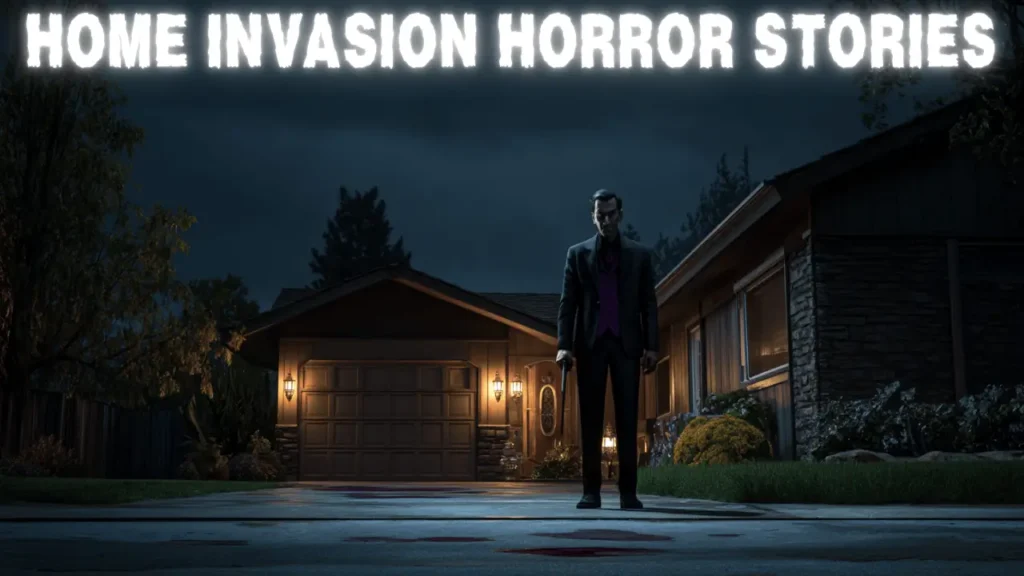
These three true home invasion horror stories are inspired by real events.
In the first story, a stalker’s meticulous plan ends in a horrifying surprise.
The next details a collector’s undoing by a tiny imperfection.
The last follows a rockstar whose sanctuary is shattered by two figures.
Watch me on YouTube and listen to me on Spotify.
Horror Story #1: Shadow Creek
For weeks, the man who called himself Jeffrey watched the house.
It was an old farmhouse, isolated, sitting a good thirty minutes from the nearest neighbor out by a dried-up riverbed called Shadow Creek.
To him, it wasn’t a home.
It was a hunting ground.
From a hidden spot across the fields, he learned the family’s routine with a cold patience.
He noted the precise time the father, John, left for work each morning in his dusty pickup truck.
He watched the mother, Amy, tending her garden.
Most importantly, he saw the oldest daughter, Maria, leave with a duffel bag on Friday afternoon.
He knew she wouldn’t be back until Sunday.
The timing had to be perfect.
On a cold Friday night in 1978, the time came.
He parked his car down the road and walked the last quarter-mile, a tool bag in his hand.
There was a reported issue with the phone lines, he’d say.
A power company check.
A simple, believable lie.
When Amy opened the door, she saw a man in a work jacket, polite and professional.
She let him in.
That was the first phase of his plan.
Control was established before the first act of violence ever began.
His initial goal, he’d later confess, was to fulfill a dark fantasy of dominance.
But once inside, that goal immediately escalated.
There could be no witnesses.
John and Amy were subdued first.
In the master bedroom, he bound them with items he found in their own home.
An electrical cord from a lamp, a belt from the closet.
The process was a meticulous display of power, meant to terrify as much as to restrain.
They were strangled, and the quiet of the house deepened.
Next was the seven-year-old, Robert.
To maintain the silence, the elimination was swift.
In his own room, the boy was suffocated under his own bedding.
But the encore, the true purpose of his project, was nine-year-old Angela.
He separated her from the others, leading her down to the old, dark root cellar.
This was the most intimate and disturbing act, designed to fulfill his need for a deep, ritualistic control.
Down in the damp cold, he used a length of specialized nylon rope he had brought with him, a detail that proved his methodical preparation.
The act fulfilled the darkest impulse behind his personal methodology.
For the next three to four hours, the house and everything in it belonged to him.
The silence that followed the violence was absolute, broken only by the house’s normal groans.
This did not disturb him.
He was not a panicked killer fleeing a crime.
He was an artist admiring his work.
He moved calmly through the silent rooms, his footsteps echoing softly.
He opened their refrigerator, took out a glass of milk, and drank it standing in the kitchen.
He treated the home like his own personal dollhouse, arranging the scene to his exact specifications.
Before he left, he took his souvenirs—tangible mementos to help him relive the experience.
From Angela’s room, he took the small silver locket she loved.
From John’s nightstand, he took the military-issue wristwatch.
Then, he slipped out into the pre-dawn darkness and vanished.
Come Sunday evening, a yellow camp bus rattled down the same long gravel road.
Sixteen-year-old Maria was finally home from her church retreat.
When the bus pulled away, the silence that settled in was heavy, the kind that presses in on your eardrums.
The house stood completely dark.
No lights, no sounds, just the whisper of wind through the tall grass.
The click of her key in the lock was a sharp, cracking sound.
When she opened the door, a wave of damp, cellar-cold air washed over her face.
“Mom?
Dad?
I’m home!”
Her voice sounded small, and the darkness swallowed it whole.
Her eyes adjusted.
Her dad’s favorite armchair was tipped over.
A dark stain, almost black in the moonlight, was on the cushion.
Two kitchen chairs were overturned.
A plate was shattered on the floor.
Her mind raced, trying to find a logical reason.
A robbery?
Had they fought off an intruder?
Her mother’s apron lay crumpled by the counter.
She called out again, her voice a shaky whisper.
“Hello?”
The silence was the only answer.
She crept toward the stairs, each creak a jolt to her nerves.
At the top of the landing, she pushed open her parents’ bedroom door.
Faint moonlight showed her enough to see the still forms on the bed.
They were unnaturally still.
She could see the dark line of a lamp’s electrical cord pulled tight across the bedding where it didn’t belong.
On her father’s nightstand, the small, empty space where his military wristwatch always sat seemed to scream at her.
A terrible, suffocating feeling rose up in her chest.
She had to find Robert and Angela.
She backed away from the door and hurried to Robert’s room.
It was dark and still.
She could see his bed.
The blankets were pulled up high, unnaturally high, mounded over a small, still shape.
It looked wrong, suffocating.
She listened for the soft sound of his breathing and heard nothing.
That’s when she heard it.
A low, metallic thunk from downstairs.
She froze.
She wasn’t alone.
The sound was definite.
Heavy.
She backed out of Robert’s doorway, her body trembling.
Another sound followed, a faint clink-clink-clink, like a chain from the direction of the basement door.
She ran to Angela’s room at the end of the hall and flung the door open.
The room was empty.
The bed was made.
Angela’s silver locket, the one she always left on her nightstand, was gone.
A cold draft whipped through the room, though the window was shut.
It carried a faint, sour smell with it, like old pennies and something foul she couldn’t name.
But Angela wasn’t here.
The sounds weren’t from up here.
They were from downstairs.
Maria turned, her heart hammering against her ribs.
She moved back down the stairs, one deliberate, silent step at a time.
The clinking sound had stopped, but another had started.
A slow, steady drip…
drip…
drip.
It was coming from the back of the house.
She crept through the dark kitchen, past the shattered plate.
The sour, metallic smell was stronger here.
The sound led her to the squat, heavy door that led to the old root cellar.
The dripping was coming from underneath it.
A small, dark puddle was slowly seeping out from the crack at the bottom of the door.
The air coming from it felt heavy and cold.
This was where the smell was coming from.
This was where the sounds had come from.
The house was now a crime scene, and it had one last secret locked behind that door.
She knew her sister was down there.
She knew she wasn’t alone in the house.
Weeks later, a typewritten letter arrived at the local paper.
It was from the killer.
It contained chilling details only the man inside the house that night could have known—the electrical cord used to bind the parents, the stolen wristwatch, and the specific nylon rope he’d used in the cellar.
In the letter, he gave himself a name: “The Shadow Creek Strangler.”
It was the beginning of a cat-and-mouse game that went cold.
The man who destroyed a family and took their small treasures was never identified.
He was never caught.
He simply vanished, leaving only an anonymous letter and an unending silence in the house by the creek.
Horror Story #2: The Collector
Wind in the Nevada desert has a sound all its own.
It’s not a howl, it’s a rattle.
You hear it when dry leaves scrape across the pavement or when empty cans clatter across a lawn in the middle of the night.
Back in the fall of 1987, that sound started to feel like a warning, a sign that something bad was on its way.
Vegas was getting bigger then, building shiny new resorts.
On the edges of the city, they were putting up these quiet little neighborhoods full of ranch houses.
Places built to be safe.
But that safety was about to get torn apart.
It started up in Reno, with an old man in a quiet suburb.
Police found him, and the scene was just…
strange.
His body had been posed, and stuck in his hand was a cheap plastic casino chip.
Detective Tyler was one of the first cops there.
He was a guy in his forties, coughed like a chain-smoker, and had the kind of tired eyes you get from seeing too much.
He’d seen mob hits, robberies, you name it.
This wasn’t any of that.
The old man’s watch, a family treasure, was gone.
But the killer left behind a worthless piece of plastic.
Tyler couldn’t make heads or tails of it.
Over the next year, the trouble moved south, down toward the new money and quiet streets of Las Vegas.
The attacks kept happening.
The news people, trying to make sense of it, started calling the guy “The Collector.”
And people got scared.
Real scared.
You couldn’t see a pattern.
The victims were all over the place—young couples, a single mom, another retired couple.
Sometimes he’d pick a lock, sometimes he’d find a door left open.
The only things that were the same were how brutal it was, and the weird, worthless trinket he’d leave behind.
The department was getting nowhere, so they brought in an expert.
Her name was Elise, a forensic psychologist from California.
She was smart, all business, and she and Tyler clashed right away.
He thought she was some academic type who didn’t know how the real world worked.
She thought he was just an old-school cop who couldn’t see what was right in front of him.
“You’re looking at what he steals,” she told Tyler one day.
“That’s not it.
You need to look at what he’s breaking.”
Tyler just scoffed at her.
“He’s stealing stuff, kid.
It’s a robbery.”
“No,” she said, looking him dead in the eye.
“He’s not taking valuables.
He’s taking things that mean something to them.
A piece of their life.
Then he either smashes it or swaps it with junk.
He wants to violate them, to tell them their memories are worthless.”
Right when Tyler was about ready to write her off completely, they got a break.
A terrifying one.
A couple, Ashley and Andrew, had been attacked.
And they survived.
Ashley could barely speak, her hands shaking the whole time.
She said the man, Zachary, made her watch while he broke her collection of antique glass.
She said the sound of it shattering, piece by piece, was something she’d never forget.
It was her mother’s collection, her whole family’s history, just smashed on the floor.
Andrew’s story was just as bad.
Zachary made him open their safe, then take out a letter his dad had written him before he died.
And he made him burn it.
Andrew said he could still smell the smoke, still hear the paper crinkle as it turned to ash.
He said the killer wasn’t angry.
He was focused.
Like he was just performing a task.
That settled it.
Elise was right.
This guy wasn’t after money.
He was after control.
He was so full of hate for other people’s happiness that he had to destroy it.
Elise figured The Collector had to be some kind of service worker.
A maintenance guy, maybe, or a cable installer.
Someone who could get into houses, scope them out, and not look out of place.
Tyler didn’t love the idea, but he couldn’t argue with the logic.
He started running background checks.
The final tip came from an eighteen-year-old girl named Lauren.
She was house-sitting in Reno.
The guy got in while she was asleep, but a phone call spooked him and he took off.
The only thing he took was a little music box.
But what she saw was everything.
“I didn’t hear his feet,” she told them.
“I heard him breathe.
He was that quiet.
And the phone cord… he didn’t just rip it.
He cut it.
It was a perfect, clean cut.
It was so neat.”
That was it for Elise.
“A perfectionist,” she said.
“He’s taking things that represent his power to get inside their lives.
A keychain, a house key.
And he kept Lauren’s music box.
He didn’t destroy it.
He wanted it.
He’s not just a destroyer.
He really is a collector.”
The search narrowed fast.
They looked for service workers known for being extremely neat, almost obsessive.
The clue that broke the case was a maintenance access card stolen from one of the victims.
It led them to a suspect: a quiet, low-level maintenance worker.
His name was Zachary.
They staked out his apartment, watched him come and go.
He was just a normal, boring guy.
A ghost.
The night they moved in, they found a key to a storage unit in his car.
They didn’t even bother with his apartment.
They went straight to the storage unit.
What they found inside was a museum of other people’s lives.
Keychains, broken bits of pottery, old wallets—dozens of trophies from his victims, all laid out in perfect order.
Tyler’s gut tightened.
He saw a small porcelain ballerina figurine that was just a little bit crooked.
It had to be new.
He reached out and pushed it an inch to the left.
Just enough for a guy like that to notice.
When they had Zachary in the box, they played it cool.
They just asked him about his storage unit.
He was calm, didn’t seem to care.
Then Tyler leaned in.
“You like to keep your stuff organized, don’t you?”
Zachary just stared.
Tyler pushed.
“We were just looking at your things.
It’s a shame about that little ballerina figurine, though.
We must have bumped it.
It was a little crooked.”
That’s what did it.
The mask came off.
Zachary’s face twisted up in pure rage.
“It’s not crooked,” he hissed, the sound coming from deep in his throat.
He flew at Tyler, a sudden burst of violence that proved everything.
Catching him put an end to the nightmare, but the final numbers were staggering.
Over two years, Zachary was responsible for the deaths of eleven people.
The list was a cross-section of the community he terrorized: four men, five women, and two children, the youngest only ten years old.
And through all the interrogations and the trial that followed, he never once showed emotion.
No anger, no sadness, no regret.
The only thing that ever truly bothered him was that one crooked figurine, a single, tiny imperfection in his gallery of death.
Horror Story #3: Silence
A quiet place, tucked deep in the Utah mountains, can play tricks on your mind.
It’s so still you start to think you’re the last person on Earth.
That snow-covered cabin was one of those places.
The year was 1964.
It was a high-end studio retreat, a sanctuary where a singer named Cynthia was creating a miracle.
She was already famous, an international voice of the new generation, and now she was pregnant.
Her new songs were about light, about the hope of bringing a new life into the world, and her voice made you believe it.
That voice was the whole reason they were there.
The engineer, Young, a man who lived through his ears, was a master of his craft.
His hands moved over the vast mixing console like a surgeon, tweaking dials with intense focus, isolating every perfect, swelling note.
He was preserving a moment in time.
Kimberly, a writer, sat quietly, jotting down lines, inspired by the energy in the room.
Paul, a friend just passing through, was there for the good company and the warmth of the music radiating from the speakers.
It felt like the safest place in the world.
The session was perfect.
Then, the power cut out.
The lights, the music, everything died for a single, jarring second.
The silence that rushed into the room was a physical thing, cold and unwelcome.
Then the lights flickered back on.
Young grumbled about the old wiring, but a feeling of unease remained, a faint static in the air.
A few minutes later, the knocking started.
It wasn’t a normal knock.
It was three slow, heavy, flat thuds against the thick cabin door, like someone was hitting it with the side of a hammer.
Everyone froze.
They looked at each other, the same question in their eyes.
Kimberly whispered, “Were you expecting someone?”
Young shook his head, his face a mask of confusion.
The silence stretched on.
The fire crackled, oblivious.
Finally, Young, always the protector, moved toward the door.
He placed his hand on the knob, gave a last questioning look back at the room, and opened it.
The moment the door swung inward, the night exploded into violence.
A figure in black stood on the threshold, and without a word, without a moment’s hesitation, swung a crowbar in a vicious, horizontal arc.
The sound was a sickening crack as metal met bone.
Young was dead before his body hit the floor.
The second attacker stepped over him and into the room.
They moved with a chilling patience, their heads turning slowly as they surveyed the scene.
Kimberly, who had been sitting closest to the door, let out a strangled gasp.
She tried to scramble backward, but it was too late.
The first attacker stepped forward and swung the crowbar again, a single, brutal, efficient motion.
She was silenced instantly.
Two friends, two lives, extinguished in less than five seconds.
A terrible, ringing silence filled the room, punctuated only by the crackling of the fire.
Cynthia and Paul were paralyzed, frozen in a state of shock so profound it was like being encased in ice.
This wasn’t happening.
It couldn’t be real.
The two attackers, their faces hidden by dark masks, stood over the bodies of their friends.
They were young, their movements calm and deliberate, as if this was a job they had done many times before.
They ignored Paul for a moment.
Their focus, their entire reason for being here, was Cynthia.
One of them walked toward her, and Paul’s paralysis finally broke.
He lunged forward, a desperate, hopeless attempt to intervene.
The second attacker moved with unnatural speed, catching him across the back with a crushing blow from the crowbar.
Pain, white-hot and absolute, erupted through his body.
He collapsed to the floor, the wind knocked out of him, his vision swimming in black spots.
He was conscious, but unable to move, a prisoner in his own broken body.
He was forced to watch what they did next.
This was the lesson.
This was the purification.
They dragged a sobbing Cynthia over to the mixing console, the heart of her art.
One of them held her fast, forcing her to watch.
The other raised his crowbar.
He began by methodically destroying the reels of tape, shattering the captured sound.
Then he moved to the console itself, bringing the crowbar down again and again, not with rage, but with the ritualistic precision of a sacrifice.
It was an execution of her voice, a murder of her art.
The entire time, they spoke to her in low, chilling whispers, their voices calm as they explained the necessity of their work.
They were The Brethren, sent by The Prophet.
Her voice, they said, was a corruption, a “false noise” poisoning the world.
They were here to restore the purity of silence.
It was not a punishment; it was a holy act.
When the equipment was a pile of ruined metal and wire, the lesson reached its conclusion.
As Cynthia wept for her music, for her life, one of the figures moved behind her.
The act was as swift and as brutal as the first two.
She was silenced forever.
They were almost finished.
One of the figures turned and walked back to Young’s body.
He knelt down, then rose.
His hand was now dark and wet.
He calmly walked to the wall and, using his own fingers, wrote a single word in the blood of his first victim: “SILENCE.”
He did it without hesitation, like an artist signing a finished piece.
Their work was done.
The two men stood for a moment, observing the scene they had created.
The three bodies, the broken equipment, the bloody word on the wall.
One of them looked down at Paul, who was still conscious, his eyes wide with a horror beyond comprehension.
The attacker nudged Paul with his boot, a gesture of dismissal.
He then looked at his partner and nodded toward Paul, a silent, clear communication passing between them.
They were leaving him.
On purpose.
They turned and walked out of the cabin, shutting the door softly behind them, leaving Paul alone in the sudden, suffocating quiet.
He didn’t go anywhere.
He couldn’t.
He lay there on the floor, the coppery smell of blood filling the air, the cooling bodies of his three friends just feet away.
The fire in the hearth crackled, a mocking sound in a room where all other life had been extinguished.
Paul stared at the wall, at the single, wet word that was still dripping.
He was the survivor.
Not by chance, not by luck, but by design.
He was the messenger, left behind to tell the world what happens when you make a sound the silence doesn’t like.